Teachers: Shine and Refine

...

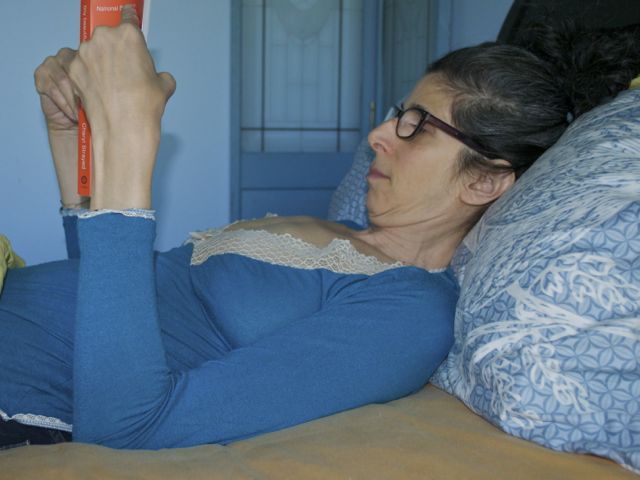
Morning Stiff Neck Pain?

Stiff Giraffe

Don’t try to stretch it out. Neck muscles sometimes spasm because they are overstretched!

Ouch, you can’t move your neck. What to do?


Stiff Neck Massage Tip:

  • Put your neck and upper shoulder muscles on slack. To do this, lean on a counter or table. Shrug your shoulder towards your ear and slump your ear towards your shoulder. Now your shoulder/neck muscles are scrunched and if you touch them, they should be soft.
  • Use the fingers of your opposite hand to move and manipulate these muscles, squeeze them between your fingers, squish and soften them. Even though there is less space in your neck/shoulder area than usual because of your shrugged position, you can effect some change in the muscles – without stretching them.

It usually takes a few days for a neck spasm to dissipate. While you wait – avoid testing and stretching it. But do try the gentle massage idea.

For the record, stretching your neck is okay, just not when you are experiencing a stiff neck from something like having “slept wrong”.

Next Blog: 3 Common Must Avoid Positions for Stiff Neck Sufferers


...

Finding Neutral for Your Neck


The curve of the neck develops after birth as we lift our head up to look around us and for some milk to drink. This desire for sustenance and connection begins the development of our neck curve.


Throughout our life, we are constantly looking ahead – still searching for sustenance and connection with others. Our neck muscles tighten to support the head in its too far forward position.


Or conversely we flatten the curve of the neck in a military style attempt at good posture. Sometimes this can result in reversing the natural curve of the neck. That was my problem years ago – trying too hard to be straight!


A neutral curve of the neck should include:

- Soft, supple muscles between the skull and top vertebrae. (See my most recent blog – Bobble-Headed Bunny Move, to figure this).

- A natural curve that moves toward the Adam’s Apple


Glide gracefully like a swan.

*Thank you Joan Arnold and Tina Goldstein for the “neck option” photos


...

Stiff Neck? Try the Bobble-Headed Bunny Move

Waking up with a stiff neck, the feeling of restriction and lack of motion is awful. It really makes you want to stretch. Don’t! Stretching does not cure everything. Sometimes it makes things worse. Stiff necks often occur when our necks have been overstretched. For instance, sleeping in a funky, neck-stretched-over position can create a spasm. Stretching makes those sensitive neck muscles tighten all over again.

How do I know this? I went through a period of chronic stiff necks from overstretching. Thankfully, now that I’ve learned this, I no longer have stiff necks. Phew!

What to do?

Lie on the floor; place your fingers underneath the highest vertebra in your neck that you can feel. Press up with your fingers to support that neck bone. Your neck will arch a bit, while your head remains on the floor. With your fingers maintaining this support, nod and bob your head, like a Bobble-Headed Animal. This miniscule movement is meant to loosen the tight muscles between the neck and the skull. Spend a minute or so with this supported, loosening movement while you breathe. When you release your hands, try to keep the softness of your neck, while maintaining it’s natural arch. Your neck has a natural curve that creates a supple and mobile YOU!


...

Yoga Teachers: Honesty

May 21, 2012

I had a student who came to my class regularly for a while. During that time, I felt that Down Dog was not really an appropriate pose for him. I suggested that he do Down Dog at the wall. I also spent time making suggestions for his home practice to open his shoulders. Still he participated in the class doing Down Dog, even though it made me uncomfortable. I could not figure out a way to skillfully tell him that he should leave out this pose. This past week, I was grateful to see a video by Jill Miller outlining specific alignment requirements for doing Down Dog safely. It’s so clear and made so much sense to me. Now I have the language to explain why a student should avoid doing Down Dog. Check it out:

Down Dog Assessment

What the teachers say about making suggestions/modifications that students don’t want to hear:

    -”If the students don’t like it, they can go to another class. Not all poses are for everyone. If I feel that someone is going to injure themselves, I tell them.”

    -”I explain that they should not worry about doing that “right now”. I counsel them after class.”

    -”From a therapy perspective, the idea is to find the internal motivation for why people continue to do the thing(s) that hurt them. I would give the pros & cons. Some of the reasons people would want to do a pose that isn’t appropriate for them:
        it makes them feel strong.
        it makes them feel part of the class.”

    -”I suggest ways to work safely to modify the pose. How can you really teach 5 or 25 people effectively??”

    -”It is challenging to address this in a group. I try to plant the seeds of what to look out for to the whole group. This puts the ball in their court.”

    Prone

   Head turned to one side, breathe. Change direction of head.
   Back Extensions: Forehead touches floor, fingertips behind head, lift shoulder blades, upper arm bones, collar bones, elbows and wrists. Lower. 10X
   Sphinx: Walk elbows to right.
   Lateral stretch: stretch out left arm, place left side of face on floor, lower right shoulder. Bring elbows back under shoulders for Sphinx. Walk back. Rep. to left side.
   Prone Twist: bend right knee, reach right foot across body to floor outside of left leg. Return center. Rep. right 2nd side.

    Child’s Pose

   Back of hands rest one on top of the other on sacrum. Rep. Upper Back extensions – lift shoulder blades, upper arm bones, collar bones, elbow and wrists. Then lower. 10X.

    All Fours

   Modified Tricep Push Up:I have always loved this exercise. 10 of these and you will feel your triceps.
       1. Lower elbows to floor without shifting hips back, elbows are directly underneath shoulders.
       2. Shift weight forward and down, face moving to space between hands on the mat.
       3. Shift back, shoulders on top of elbows again.
       4. Straighten arms.

    Down Dog

   We took a good long look at Down Dog to determine where ‘back’ is since we were attempting to move our shoulder blades, upper arms bones, collar bones, elbows and wrists in that direction. Then thought up some reasons why this might be a good direction:
        It might open the chest.
        It could give a could structure to the back musculature and a safer placement for the shoulder joint.
        The weight of the body could shift more to the fingertips, which helps balancing away from the wall in handstand.

    Pilates Legs:

    Begin leaning back on elbows, forearms planted parallel with palms flat, knees bent, feet flat. Draw both knees together into chest, balancing on the center of sacrum with abdominal muscles drawn inward, point toes.
       1. Extend legs to about 45 degrees, or less, depending on the ability to control abdominals. Avoid arching the spine.
       2. Externally rotate legs.
       3. Bend knees while maintaining external rotation – knees open while toes stay together.
       4. Draw knees together. Rep 4X.
       Reverse direction, starting with 3, 2, 1 then back to 4.

    Surya Namaskar

   Arms overhead, crossed palms pressing
   Side Bend
   Step Backs with Modified Tricep Push Up instead of KCC (= Knees, Chest, Chin), back to all Fours instead of BC (= Baby Cobra).
   Round 2: Down Dog Split, one knee down for KCC, back to all 3′s to Down Dog split, lunge.

    Standing Poses

   Vira 1
   Goddess Pose
   Vira 2
   Trikonasana

   Tadasana with Gomukhasana Arms
   Natarajasana at wall.

    Back Home On The Mat

    Dhanurasana with Strap

   Supta Padanaustasana Variation

   Savasana


...

Yoga Teachers: Building Compassion

April 23

How do you express your compassion?
   - Through my voice. Volume and tone can have a powerful effect.
   - Being calm & centered in yourself. Then you can really listen.
   - Listening and relatedly meeting people where they are.
   - Empathic listening. Listening with every part of me.

How can we increase our compassion?

   - When I am in the habit of meditation my compassion increases.
   - Work at listening. Thoreau has a quote about how we look at things all the time, but don’t really see them.
   - Becoming aware of my habits, things I do to numb painful feelings which in turn lessen my ability to be compassionate. Being aware of my breathing.
   - Increasing length, width and depth of my Sushumna nadi.

Sukhasana Warm Up:
   Prayer hands
   Open arms to side at shoulder height – unfolding first shoulders, upper arms, elbows, wrists, hands and fingers, palms face forward.
   Big rounding of spine with arms circle forward – hug an imaginary stability ball.
   Fingers interlaced, arms overhead
   Twist left, arms still overhead
   Cactus arms, elbows level with shoulders, forearms perpendicular to floor, wrists netural
   Right hand down to left knee, left hand behind
   Face forward, bring left arm on top to hug. Compassion starts here at home.
   Eagle arms, left arm on top
   Eagle with bent leg boat
   1/2 boat, arms unfold forward
   Rock the body, while maintaining the distance between the legs and the torso
   Rep 2nd side

Bird Dog & Friends: All Fours
Here we looked at each other closely to observe and assist alignment of back leg. We can’t see the back leg extended behind us, so we are working to develop our awareness from an inner sense.
   Right leg back at hip height
   Bend right knee, thigh still parallel to floor, lower leg vertical, ankle circles
   Extend right leg
   Dog at Hydrant, right leg bends and moves to side – hip, knee and shin all equidistant from the floor…
   Place right foot down, Parighasana
   All fours: Knees, Chest, Chin
   Shalabhasana, holding edges of mat
   Anantasana, lying on left side, with top leg extended
   Keeping side of left leg grounded, swing top leg back behind your hips, toward 90 degree angle with long left edge of mat, hands/torso walk toward right off mat. Angela Farmer called this Dead Warrior.
   Legs together on abdomen
   Balasana

Down Dog

Lunges:
   Airplane arms, chest on thigh
   Big contraction/rounding of spine, arms circle around imaginary stability ball (fingers reach under front leg),
   Lift hands above front thigh, interlace fingers and press palms upward,
   Straighten back leg for high lunge
   Parvottanasana
   Rep 2nd side

Uttanasana
Down Dog
   Lunge right
   Keeping right leg straight, bend back knee to ground
   Turn out right leg, for lateral hamstring stretch
   Bend right knee for turned out deep lunge, hands walk forward onto elbows possibly
   Hands under shoulders, straighten back leg and lower heel back heel, turn front toes forward,right hands flat down on inside of right foot
   Parsvakonasana, peel open left arm
   Vira 2
   Trik
   Rep 2nd side

Handstand
   Lower one knee to chest, straighten leg
   Rep 2nd side

Supta Baddha Konasana

Savasana

Time flies when your are having fun!


...

Yoga Teachers: When Our Students Say ‘I Can’t’

April 16

What to say (do or feel) when our students believe that they lack the ‘appropriate’ range of motion and say that they’ll never be able to do the pose fully.

- Think of yoga as a process.
- Work with inner dynamics in the present moment.
- Work on the mechanics.
- “I have seen that and felt it in myself”.
- Break down the pose into steps so that the student can feel successful in part of it.
- Work intelligently with what you have.
- Offer compassion and your presence.

Supine Calisthenics:
   Shoulder flexion
   Hip flexion – Bicycles
   Inner thigh adduction, starting parallel and moving open with turned out legs. Closing legs back to parallel.
   Twist with Shoulder circle

Sukhasana Warm Up:
   Bow head to shine crown chakra forward. Continue to fold forward, third eye chakra turns in and down. Soften throat, then heart center beginning to walk hands forward. Release solar plexus, navel and pubis. Breathe.
   Lift crown up like a turtle coming out of its shell. Lift third eye, throat. The lift of the heart chakra begins to lift us upright. Lift solar plexus, navel and pubis. Sitting in Sukhasana in a slight back bend.
    1/4 turn crown chakra to side bend to right. Right hand on top of left hear for neck stretch. Continue to side bend, right hand releasing to floor and left arm overhead.
   Return to vertical.
   Left hand across body to right knee for twist to right.
   Return to center for 2nd side, changing crossing of legs.

Bird Dog:
   Extend right leg back
   Bend back knee up, circle right ankle
   Extend right leg back
   Extend left arm forward
   Bend back knee up again, circle ankle
   Lower knee & hand
   Circle right arm back, then up to twist, preparing for
   Thread the Needle

Lunges:
   Deep lunge
   Parsvottanasana

Down Dog:
   Here we took a look at the places that we tend to sink/sit in our pose.

Urdhva Hastasana Arm Swings to Forward Bend, with bent knees 3X

Standing Balance:
   Right knee to chest
   Ankle circles
   Extend right leg
   Turn out right leg
   Tree Pose
   Kickstand Tree Pose
   Roll forward through sequencing as in Sukhasana Warm Up. First crown, then 3rd eye, throat, heart center, begin to reach hands to floor or blocks, solar plexus etc.
   Standing Hip sink and lift
   Reverse: lifting crown first. Though we came up to a slight backbend in the Sukhasana Warm Up, here we want to return to neutral

Standing Poses:
   Vira 1
   Swing arms into Parsvottanasana
   Vira 2, with body hug around and imaginary stability ball in front of belly/chest
   Trik

Standing Quad Stretch

Toe Stretch with belt around heels:
   Flexed feet

Pinca Mayurasana

Toe Stretch with belt around heels:
   Toes pointed

Pinca Mayurasana

Ustrasana a la Angela Farmer:
   Begin in Child’s pose
   Lift crown, 3rd eye, throat (shoulders begin to retreat), heart center (body begins to lift), solar plexus (hands reach back towards heels or blocks), navel & pubis.
nbsp;  Reverse, lowering pubis first (pelvis lowers), then navel, solar plexus, heart folds forward, throat soften & closes,3rd eye and finally crown lowers.

Choose your neutralizing pose before

Savasana


...

Yoga Teachers – Teaching Poses We Cannot Yet Do?

April 9

Do we need to be able to do every yoga pose that we teach?

* One teacher said that she mostly avoids teaching the poses that she cannot do. Though she does sprinkle them in occasionally.
* Another said that it is all a process.
* From another teacher, “I fluctuate between hiding from my students what I can’t do and fully revealing to them my version of the pose in progress whatever that may look like.
* My thoughts: being challenged in poses, then figuring out how to do them – will make us better teachers. We’ll develop the precious skills to communicate what we have learned.

Chakra Warm Up:

   Rub hands together, creating warmth
   Place palms over eyes
   Move hands down to throat
   Heart center
   Solar plexus
   Navel
   Pubis
   Top of thighs
   towards knees
   OM

Sukhasana Warm Up:
    Fingers interlaced, palms press front, then up
    Tricep stretch: right elbow up, left elbow down at side, fingers still interlaced but palms face in towards body
    Side bend, left
    Extend arms forward, cat back
    Tricep stretch, left elbow up and side bend right
    Return to vertical, release arms down
    Right arm winds up and swings across body to left knee for vertical twist to left. Second time through, winds up to release right elbow to outside of left knee, turn your spine/chest to fold over left knee – left fingertips on floor support turn.
    Forward bend, walk arms forward
    Walk back up to vertical
    Rep 2nd side

All Fours:
    Bird Dog Plus
       Right leg back
       Small circles with right leg
       Keep circling right leg, add left arm extension
       Circles with arm and leg

Lunges:
   Deep lunges alternating with Parsvott

Surya Namaskar: a la Sondra Loring
   including toe work for DD to UD toe roll over

Standing Poses
   Vira 1
   Parivritta Parsvakonasana
   Vira 1
   Trik Prep
   Rev. Trik with top arm in Gomukha variation (Tricep stretch from Warm Up – left arm up first time with right foot forward)
   Rev Warrior, extend arms
   Trik
   Parsvakonasana
   Visvamittrasana
   Eka Pada Koundinyasana
   DD
   2nd side, end in Child’s pose

Hip Opening & Fun Stuff:
   Baddha Konasana
   Mulabhandasana
   Hold heels for Upward Upavista Konasana
   Ankle to Knee pose, attempting to get there without using hands

Savasana


...

Yoga Teachers – Does Therapeutic = Feel Good?

April 2

If something is therapeutic, does that mean it feels good?

   *One teacher said that she followed the ‘no pain no gain’ philosophy. If something is therapeutic, it should hurt.
   *Another teacher said that when she first started practicing yoga – eveything hurt: her back, her knees. That was all part of her path. Now she feels differently.
   *It seems some students feel that yoga should be relaxing and easy. They can be very cautious and won’t go to their edge where the possibility for change exists.
   *How DO we know when to back off and listen to our body, and when to go forward with discomfort or even pain?
   *Asking for the opinion and guidance of a trusted source could be a helpful step.

Supine:
    Shoulder flexion
    Hip flexion, with hamstring stretch
    Garuda legs: in & out
    Garuda legs in boat
    Rep 2nd side

Sukhasana Warm Up:
    Arms up
    Gomukha arms with forward bend
    Twist
    Side/Twist/Back bend
    Rep 2nd side

All Fours:
    Bird Dog, forever
    Parighasana Prep
    Figure 8′s for hip
    Child’s Pose
    Rep 2nd side

Down Dog
Plank
Knees Chest Chin
Sphinx
Shalabhasana
Side lying Shalabhasana

Lunges
    Deep lunge to Parsvottanasana several times before holding Parsvott.

Utt

Standing Poses
    Vira 1
    Parsvott. Prep with Gomukha arms
    Pari Trik
    Twisted Child
    Vajrasana
    DD with twist
    Vashista
    DD to jump forward
    Rep 2nd side

Handstand

Hip Opening a la Glenn:
    seated one knee flexed foot flat, opp leg ext like Upavista
    Rep 2nd side
    Squat

Ardha Urdhva Dhan with Shoulder Opening
    Shoulder flexion
    1/2 wheel with shoulder flexion
    Lower torso, one vert at a time, with arms overhead
    Urdhva Dhanurasana or rep Ardha Urdhva Dhan

Jathara Parivarta

Savasana
    to You Can Close Your Eyes by Matthew Sweet and Susanna Hoffs


...

Yoga Teachers: Shine & Refine – Listening

Monday, March 26

Buddha said – (Anguttara Nikaya III 248):

There are five advantages of listening to the dharma. What five?

   One hears things not heard before,
   clarifies things heard before,
   dispels doubts,
   straightens one’s ideas,
   and one’s mind is delighted.

On Monday afternoons, among other things yogic that are taught in the little Kids classes, we attempt to teach listening. Often there is a continual clammer and humming. The Kids need to be heard and need to hear themselves. So, we listen to the sounds in and around the studio. This creates a blessed moment of quiet. Is it possible to hum and listen at the same time? How do we practice listening? Listening like relaxation will take practice. So, we practice.

Sukhasana:
    Broaden back of thighs/internal rotation
    Find ease, lift, lightness
    OM – listen to the beautiful sound

Standing Warm Up: to the short song, Treasure but Thievery Corporation
    Shake hands, elbows, shoulders, twist, hips, knees & ankles

Shoulder Opening with Strap: big pec stretch
   with Utkatasana
   fold strap, lat pull & side bend
   Rodney’s party trick

Down Dog, plank, baby cobra, Anantasana with Tree variation

Lunge – Deep lunge – Lizard lunge – Parsvottanasana

We looked at each other in lunge, attempting to open the top of the back leg thigh. No more wrinkles…?

Utt

Parsvott Prep with flossing strap action:
    One arm is forward and up/externally rotated, the other is back and down/internally rotated. Using a pulling action deepen each arm stretch one at a time.
Utkatasana with twist
Rep 2nd side

Standing Pose Sequence:
    Tadasana, hugging arms around shoulders, then extend arms up
    Step left leg back – Vira 1
    Prayer hands to floor on inside of front foot
    Turn left for Prasarita, back of hands on floor through legs, then return to vertical
    Vira 2, right leg forward
    Clunky transition to back of mat for Tree Pose, right leg up
    Utthita Hasta Padangustasana, right leg extended
    Standing ankle to knee – right ankle across left knee, forward bend & straighten standing leg
    Lower right ball of foot, still externally rotated, to outside of left foot
    Pivot – walk hands counterclockwise to back of mat, lift left heel, continue to pivot on balls of feet, walking hands to face long right edge of mat – Uttanasana
    Continue walking hands 1/4 circle more to prep for Side Crow
    Extend for Vashistasana on left hand
    Down dog, jump to Utt, 2nd side.

Handstand

Child’s Pose

Prone Savasana
    with weights at top of thighs


...

Yoga Teachers: Shine & Refine – Paradoxes of Teaching

March 12, 2012

Paradoxes of Teaching:

   While we are all busy teaching, as teachers we seem to be starved for the time to practice ourselves.

   We teach, yet we are often the ones who are really learning.

   We attempt to teach our students the ability to be present, yet sometimes they don’t seem present to receive this teaching.

   How can we stay open and generous, when we see that over-concentrated look on our student’s faces that makes them look angry and mean?

These paradoxes are part of the complex puzzle of our lives, our teaching and our practice. We relax our abdominal muscles and then work on our core… Both! These paradoxes are nature doing it’s thing – all part of our process.

Core Work:
    Seated Low abdominal engagement:
        Reverse curl, using rolling ball as a visual/manual cue
    Supine Upper abdominal engagement:
       Pilates Rib/Arms

Proprioception Work for Ankles:
   Supine Supta Padangustasana (no belt)
       Ankle circles with awareness of sole of foot’s relationship to ceiling and hip.

Lunge Sequence:
   From All Fours: Lunge, Parsvottanasana, Uttansana, Uttanasana with one foot on block, Uttanasana, Parsvottanasana. Rep 2nd side.

Standing Poses:
Garudasana
Vira 2
Trik.
Ardha Chandrasana
Standing Split, Quad stretch, Lifted/Turned out
Ardha Matseyendrasana
Bunny Rabbit prep for Gomukhasana
Parivrtta Parsvakonasana
Deep lunge:
   with one foot on block
Uttanasana
   with one foot on on block
Uttanasana
Rep 2nd side.

Handstand

Legs Up Wall:
   Ankle to Knee
   1/2 Happy Baby

Savasana


Next Page »